Flora and fauna of the Athens County area, and occasionally habitats outside Ohio. Subject matter will consist of both interpretive material and taxonomic issues in plant and animal identification.

Friday, September 13, 2013

Summer Wanes (updated)


Chestnut Oak, Quercus montana (prinus)

The sun sets earlier every day. That means school has started, and my posts will probably dwindle. These are just a batch of photos I've had sitting around for six weeks. Spiders, ferns, aphids, etc. will be placed in their respective older posts on those subjects. I pulled some pics out that were originally here and put them elsewhere, and added others to update my hiking around.


This critter decided to hang around and let me photograph him. Most of these tend to fly or jump away. It's a Meadow Katydid. They are divided into greater and lesser katydids. I think this is a Greater in the genus Orchelimum. Common Greater Katydid, O. vulgare seems most likely.

You'd think with those eyes and brown marks on the head and thorax, it would be easy to narrow down. Not really, many of the species are similarly marked. You need to see the sub-genital plates at the back of the abdomen.


Same goes for this relative I found nearby. This is a Bush Katydid of the genus Scudderia. You have to look at the genitalia. No dissection needed mind you, but you have to have the specimen in hand.

As soon as I tried to get a closeup of the abdomen rear, he turned around, and those eyes were giving me a very nasty dirty look. I decided to pass.


The Orb spider that sits facing up instead of down. Arrowhead Weaver, Verrucosa arenata, and an unlucky wasp.

Rough Bedstraw, Galium asprellum. Really, how can you tell? Well you can't by this photo.

Touch the stems and you'll see where the name comes from. They have little prickles that stick to your clothes like the larger Clinging Cleavers bedstraw. Once I have around 10 species photographed, I promise I'll do a key on separating them all.

Every late summer and fall certain numbers of American Beech trees will show white lines on the edge of the twigs.

These are Wooly Beech Aphids, Grylloprociphilis imbricator. At this time of year Aphid colonies will consist of winged males for mating. Throughout the summer many species of aphids have populations made up entirely of females only.

Beneath the Beech trees you may often notice what looks like piles of old charcoal briskets dumped on the ground. This is developing Sooty Mold Fungus feeding off the sugar water or honeydew excreted by the aphids.

Many Aphids, including the wooly ones, can be rather species specific to certain plants. This is the Apple Wooly Aphid, Eriosoma lanigerum on Wild Crabapple.


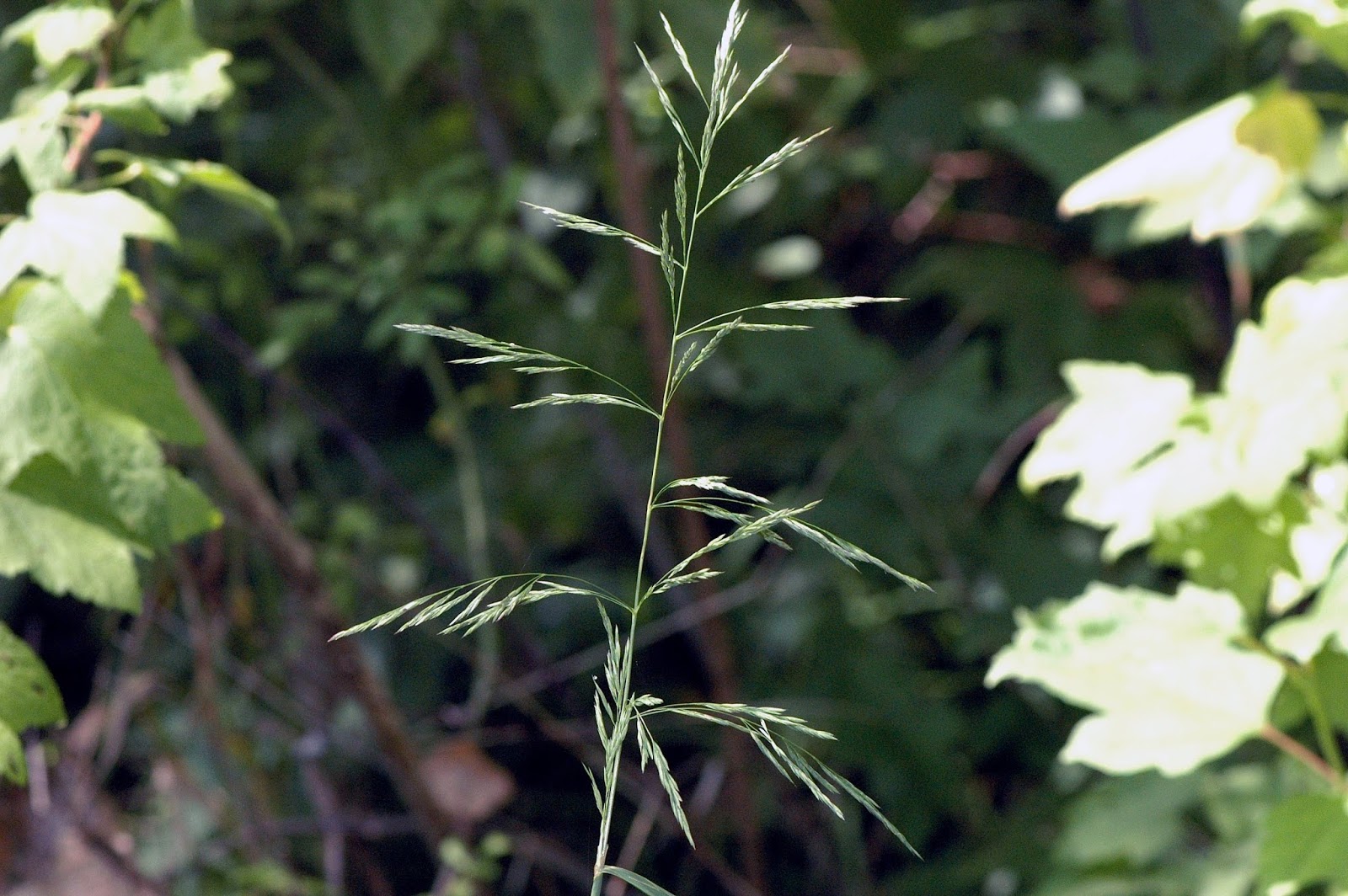
Calamagrotis canadensis, known as Bluejoint Grass. This is a clump forming species. Although this was seen in a fen, it is a widespread species found in any wetland. Ducks and Muskrats feed on the seeds, and the clumps make excellent nesting material. No surprise that it's an important species in waterfowl management, especially in the upper half of Ohio and along Lake Erie.


Wood Reed Grass, Cinna arundinacea. Maybe not as important in wildlife management as the Bluejoint, it's still common everywhere. In sunny openings, the seed heads are much more dense. In heavy shade they appear a bit sparse. This form looks similar to Slender Wood Reed, C. latifolia, but that is an endangered species in the state, found only in two counties of NE Ohio.

The best time to wander into prairies is mid to late July. But even a month later you'll still find plants in bloom. Two favorites of mine include the Spring Ladies Tress Orchid, Spiranthes vernalis on the left, and the Tall Green Milkweed, Asclepias hirtella.


A common hairy vine with three leaflets and purple flowers. This is Hog Peanut, Amphicarpaea bracteata. I have found this in just about any open area habitat. A showy member of the Legume family.

Also common in open sites is Hypericum hypericoides. Most St. Johnswort Hypericums have 5 petaled flowers. These with four yellow petals are known as St. Andrew's Cross.

Turkey Tail Fungus, or at least that's what I think. Fungi and Mushrooms is a subject I know very little about. I have enough photos to do several posts on this group, if I can ever find an expert to sit down with. I know several people who are familiar with the edible species, but I don't take a lot of pictures of toadstools and puffballs, I look for the weird instead. Things like Jelly Fungus, Coral Fungi, Dead Man's Fingers, and things like that.

In late summer, the Winged or Shiny Sumac, Rhus copallina, is an excellent source for insect photography. Most of these plants have now gone to fruit.


While working on my second post about ferns, this species eluded me throughout Athens and Hocking Counties. I had to go to western Ohio to get it, and found it in abundance in wetland habitats. Thelypteris palustris, the Marsh Fern, (palustris means swamp). The pinna, or leaflets, occur in both this skinny and broad form.

Most of the plant is smooth to the touch, but the central rachis or stem is quite hairy. One identification character I noticed that was consistent on all the plants was the basal leaflets next to the rachis are bent inward.

The sporangia are not produced on a separate stalk, but on the undersides of the pinnae. Most ferns prefer a woodland setting. Look for this in open areas.


White Wood Aster, Eurybia divaricata. This is a common shade tolerant species currently in bloom in dry forest understories. The lower leaves are arrow-head shaped, broad, and on long stalks. The upper leaves become minute.

Most of the time they have a rather flat-topped bloom, but on vigorous plants, the flower head may be more umbel shaped.


A student sent me this picture of a Tree Burl on Oak. Burls are found on many tree species. They can be caused by several factors. Fungi, a virus, insects, or some damage to the cambium layer. Sometimes stunted twigs and buds that can't break through the bark may cause it. Many trees actually have burls on their roots. Burls don't kill the tree, but a bunch of them on the same tree may be so heavy, the tree can't hold up the weight. Burls are often cut off the tree and milled into very decorative pieces highly sought by wood workers and artists.

There's a bounty in the county on caterpillars right now. So I'll try to get out and about with the camera some how. But with the semester starting, I've got other things to do, like sit a bit in the office too. I have to feed the need of students greed to learn about Dendrology. Hey, it's okay. Let's just hope I'm not stuck with bad luck, cause it's Friday the 13th.

Monday, September 2, 2013

Thyatirids, Apatelodids, and Hooktip Moths


There are two species of Apatelodidae moths in Ohio. This is the Angel, Olceclostera angelica. 7665
A gray moth with two curvy brown stripes in the wing. Apatelodids sit with their wings flat over their body in a triangle shape.They often stand on their head and hold the abdomen up in the air. The wing margins are scalloped or uneven. Members of the family have one or two white, somewhat translucent spots, near the edge of the upper wing.


As with previous moth posts, all pinned specimens are the property of Jim Vargo. The live shots are mine, unless indicated otherwise. The numbers reflect the Hodges checklist.


7663 Apatelodes torrefacta. Called the Spotted Apatelodes, I have always known it as the Wild Cherry Moth. I see this more often than the previous one. Another gray winged species, the key difference is the black stripe near the base of the forewing. Large black spots on the wing and thorax are also distinct. The hindwing is rust colored. When at rest, they often keep those hind wings hidden. It's a cherry, oak, and maple feeder.


Thyatiridae moths. To me they have a mix of both Prominent and Noctuid characters. The best way to distinguish them is to simply learn the species. There are only four in Ohio. This one is Habrosyne scripta, the Lettered Habrosyne, 6235. More common in northern Ohio, it has a wide range from coast to coast in N.A. I would expect to see this in other parts of the state.


Habrosyne gloriosa, the Glorious Habrosyne 6236, is the more widespread species in Ohio. It is nearly identical to Lettered, with a couple subtle differences. The white line bordering the large gray patch is bent in both species. In gloriosa it forms a nearly square or 90 degree break. In scripta it is only slightly bent. The pink-white line that borders the wing edge is straight in gloriosa, and more curved or boomerang shaped in scripta.


6237 Pseudothyatira cymatophoroides, the Tufted Thyatirid. This moth occurs in two color forms. The black marks may be present or absent. It's call tufted for two reasons. When at rest you can see a tuft of hairs on the thorax sticking straight up. Also, follow the outer forewing down to where it meets the hindwing. Notice a "tuft" of rusty scales. These also stick out on the moth when the wings are folded.


6240 Euthyatira pudens, Dogwood Thyatirid. Another species with two color forms. Easy to recognize with the big white spots, even the lighter form still shows some of the same spots. In fresh specimens, those white spots are often tinted with pink.


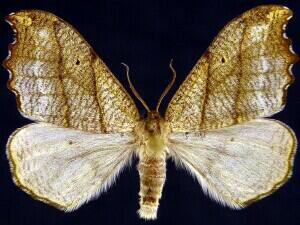
The Drepanidae family, commonly known as Hooktip Moths. You can see the wing tips curve into a sharp fish hook shape. That is typical, but not all species show those tips. Seems there are always exceptions in every group. This one is Drepana arcuata 6251, the Arched Hooktip. Yellow-brown in color, often lighter on the outer portions, with a dark curved line up the middle. A thinner brown line often borders the thicker one. These moths can easily be mistaken for Geometrid Inchworms, but have a shorter stouter body.


6252 Drepana bilineata, the Two-lined Hooktip. Like the previous, there is a yellow-brown look to the wings. In the first form, a net-winged appearance is also helpful. The hook-tips are there, but the wing margin is more scalloped in this species. Whether a light or dark form, the name tells you what to look for, two widely separated brown stripes. This species is found primarily north of Ohio.


6255 Oreta rosea, Rose Hooktip. Although the center is still a brown color, the yellow makes this easy to recognize. The hook itself may be dark brown to purple. Occasionally this species will be found in an all orange form.


6253 Eudeilinia herminiata, Northern Eudeilinia. This is one of those species that lacks the hooked tip. Look for a dark chain like pattern on both sets of wings. Again, those short stout bodies help in separating this from several white Inchworm lookalikes. This species is found in every state surrounding Ohio. So look for it in places besides the northern counties. Not much of a common name, but it's called northern because there is a nearly identical species in Florida. On that one, the dark spots are a lighter yellow-gold.


Scoopwings, Sackbearers, & Window-winged Moths


                                Bob Patterson photo
Scoopwings, Uraniidae (Epiplemidae), are a small family of moths that also resemble some Inchworms. There are only two species here. 7653 Calledapteryx dryopterata, the Brown Scoopwing. The wing edges are scalloped in this species. Rather than paying attention to the small stripes, I look for a dark patch at the base of the forewing, and one at the outer edge of the upper forewing section.


When at rest, Scoopwings frequently sit with their front and hindwings apart from one another. This gives the appearance that a portion is missing, as if they were bitten by a bird or bat.

7650 Callizzia amorata, the Gray Scoopwing. Similar to the above, but overall base color is gray not brown. The forewings are less scalloped, and the hindwings contain more black. Records indicate it is found from coast to coast. I have collected it in Michigan, but haven't seen it yet in Ohio.


Mimallonidae family, known as the Sack-bearers. The name comes from the behavior of the larvae. Caterpillars build a purse, or sack of silk around their bodies, and spend the winter in a sleeping bag. They pupate the following spring. The adults are fat bodied and hairy. They may be mistaken for a small Silkmoth. This one is Lacosoma chiridota 7659, the Scalloped Sack-bearer. This is the female. The name points to the obvious irregular pattern of the wing margins.


7662 Cicinnus melsheimeri, Melsheimer's Sack-bearer. This species is larger than the previous. The color is a light pink-orange, and the wing edges are much more uniform. I made up my own name for this. I call it the peppered sack-bearer. It looks like the wings and body have been dotted with black pepper. Again, there are several Inchworm moths that have similar looking stripes in the wings, but Inchworms don't have bodies this fat.


Thyrididae, the Window-winged Moths. Well they may be called that, but you can't really see through the windows. They are translucent at best, but not transparent. These are small moths often seen at flowers during the day.

6076 Thyris maculata, Spotted Thyris. The thorax is bright yellow, and the wings will be spotted with small orange-gold dots. These moths tend to show both sets of wings when hovering, so the white spots  are easily seen.


6077 Thyris sepulchralis, the Mournful Thyris. It's in mourning, so it's wearing black. With that background, the white spots make this easy to identify. This species also wears a white collar around the neck. The short blunt wings serve to separate it from any other black and white moth. There are a few records north of Ohio, but this is a species of the southern states.


6078 Dysodia oculatana, the Eyed Window-wing. You have to look close to find those window patches. The yellow orange mix give this moth a brassy, shiny appearance.