It has been said that any sane person attempting to learn the 160+ species of
Carex in Ohio must be insane. Who said that? I did! Seriously though, I want to thank Rick Gardner for showing me the 17 million, eh, I mean these nearly 50 species on our walks. Rick is trying to turn me into a sedge head, but like any subject, it's use it or lose it. Sedge season is May and June, so now I have to wait another year to practice in the field.
Having never worked with sedges, I will approach this purely from a layman standpoint. Some technical terms are needed to describe parts of the plant, but I'll mention them frequently enough, you'll get used to it. I was going to go over these first with a couple of folks, but a number of other people said just post it and don't worry. So I will use some colorful language to put my own spin on this group. Like many other natural history topics, there are some species that can NOT be reliably identified by photographs, even if the pictures are labeled correctly. A hand lens is needed to see minute variations between species that may not be visible here. You may come away from these posts still thinking they all look alike, well, they do, ha!
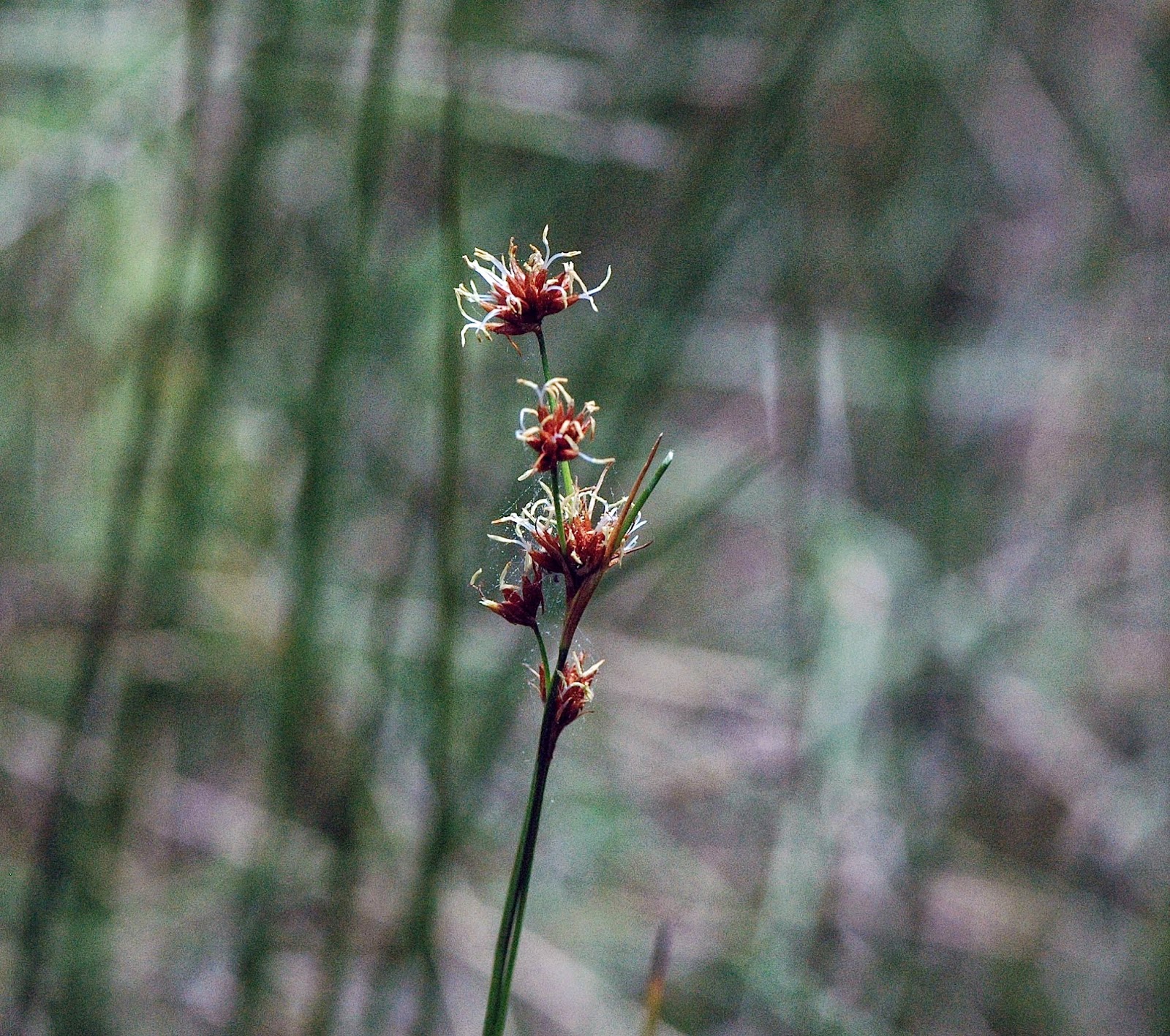
Green Bulrush,
Scirpus atrovirens.
Woodrush,
Luzula echinata. Rushes belong to the
Juncaceae family, and can be mistaken for sedges.
Flatsedge,
Cyperus.
Spikesedge, Eleocharis sp. (obtusa perhaps?)
Twig-rush, Cladium mariscoides. Like Carex, these are all members of the
Cyperaceae family. Sedges have edges, or are triangular. Rushes are round, and grasses are hollow. That is only a general rule for these groups. There are always a few that want to break the rules.
Carex hirtifolia.
Carex pensylvanica. Most Carex sedges are associated with wetlands, but there is a batch of them found in more upland woods. Some, like these, have rather brilliant flowering structures, and are often pictured in wildflower books.
The first group I'd like to cover are what I call the 'inflated' species. The following three species have the look of a
flail or
mace. This is
Gray's Sedge, Carex grayii. Those balloon like structures that look inflated and pointy are called
perigynia. They house the
achene or seed. On Gray's Sedge, these points radiate out in an almost 360 degree fashion. To me they also have the look of those old
deep sea mines. This is a common species found through much of Ohio.
Bladder Sedge,
Carex intumescens. Looking very much like
grayii, the Bladder Sedge has perigynia that spread outward and upward, but
rarely downward. So instead of appearing round, it looks like the lower half has been cut off, giving it a flat base.
Louisiana Sedge, Carex louisianica. Found at Lake Katherine, this is an extremely rare species in Ohio. It's not globose nor semicircular. The spikes are narrower or elongate, as if the perigynia are stacked one on top of the other.
Using my warped imagination, let's compare the three using that deep sea mine I mentioned. With the spikes radiating out in every direction, this would be
Carex grayii.
With the bottom part of the mine cut off, you have
Carex intumescens.
With the entire fruiting structure elongated, you have
Carex louisianica. Okay, enough of that.
Tuckerman's Sedge,
Carex tuckermanii. Instead of all the perigynia clustered together, these are stretched out, giving the appearance of a long blow up party balloon. Each perigynia is very round, but suddenly blunts to a long beak. The upper most fruits are often erect. Lower ones may hang to the side because they have a longer stem or
peduncle. The achene inside is different from other sedges in having a notch or indentation, giving it a kidney bean shape. You need a hand lens to see that.
Squarrose Sedge,
Carex squarrosa. We leave the balloon sedges behind and move into the group with a more 'tighter packed' look. This and the following species are what I call the Gum-ball or Button sedges. The short round head is distinct, and the vast majority of plants show only
one fruiting head at the end of the stem.
Cattail Sedge,
Carex typhina. Some say the fruit reminds them of a mini cattail. I don't really see that. Though it does grow tall, and has wide leaves like a cattail. To me it is just a more
elongated squarrosa.
When you put them side by side, you can notice three differences. 1) t
yphina has a longer fruit head. 2)
typhina will have 2-3 fruiting spikes,
squarrosa only one. 3) The spiny beaks of
typhina will point outward or upward. The bottom spines or beaks of
squarrosa point downward.
This next batch I eloquently call the 'caterpillar sedges'. I think you can see why.
Long-hair or
Bottlebrush Sedge,
Carex comosa. Appropriate common names to be sure. If any species ever looked like a green caterpillar, it's this one. The spikelets are very long and crammed with a
huge number of perigynia. The base of each perigynia is small, not globose like the inflated species. The beaks at the top of the perigynium spread out in all directions, giving it a
fuzzy appearance. With a hand lens, they look like a bunch of baby birds with their mouths open.
Blister Sedge,
Carex vesicaria. Another elongated fruiting species. The beaks do NOT spread out like
comosa, so there is no fuzzy look. The perigynia are fewer and less crowded. The bases of each are
more swollen, and they taper to a sharper point.
This second picture shows a more typical narrow form. Late in the season the color fades and they look more like a bunch of onions. The perigynia appear more uniform, as if arranged in rows. The first time I identified this one they were yellowish, and reminded me of an ear of corn.
Frank's Sedge or
Bristly Sedge,
Carex frankii. This wetland sedge has fruit that tend to grow erect and hug the stem. The perigynia look flat or deflated, and compressed together, each one forming a diamond pattern. The beaks are long and thin, giving it a bristly or hairy appearance. On similar looking sedges, the pistillate and staminate spikelets (male & female), grow together. On Frank's Sedge, the staminate spikelet is on a
separate stem.
Sallow Sedge,
Carex lurida.
Hop Sedge,
Carex lupulina.
Sallow Sedge above, Hop Sedge below. These are not quite balloon like, and not quite caterpillar like. I call them Porcupine Sedges. I suppose you could call them spiny 'stubby' caterpillars. Both of these are common around the state. They are short peduncled and tend to hug the stem. Hop Sedge does have inflated bases, but nothing like the
grayii group. You notice the sharp spiny look before anything else, at least I do. Same goes for
lurida. With age
lupulina turns white to brown, while
lurida turns yellow.
This may be another Porcupine Sedge known as
Carex hystericina. Rick was unsure about this one and stated, as I so often do, that identification by a photo alone can be unreliable. We didn't have the specimen in hand.
hystericina has a shorter fruiting body than the previous two. It looks more like a 'shriveled' caterpillar. It has long peduncles, which results in the fruit usually drooping like this.
This one is rather unique, so I don't need to put it in a group. It's easy to identify. Now watch someone tell me there are a bunch of others that look like this that I just haven't seen, that would be my luck. The
Fringed Sedge,
Carex crinita. People could mistake this for a Foxtail, a Canada Rye, or other drooping grasses. The perigynia are slightly inflated, but from a distance appear flattened. They have a short beak. The hair like look is due to the
awn like scales that protrude between the fruit.