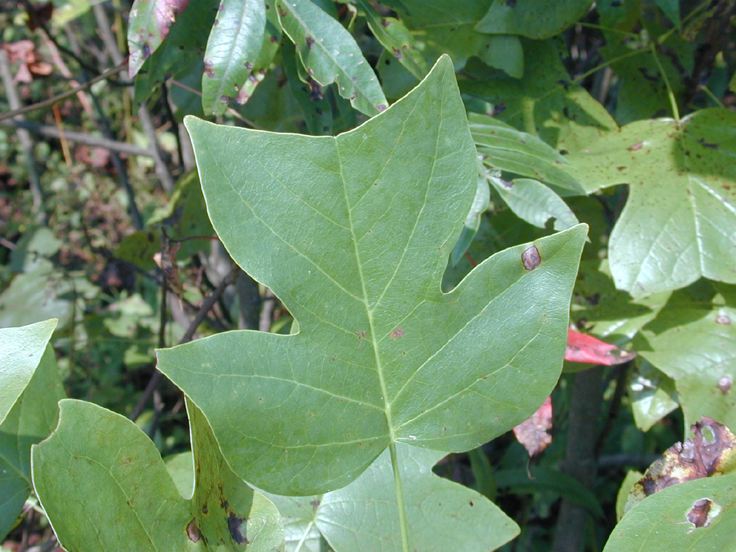
I decided to go out today and observe the damage being created by this scale for myself. Most Tuliptrees I saw were covered with Scale insects. Here is the Black Sooty Mold I mentioned in the previous post starting to cover the leaf.
If you wonder whether or not you have aphids or scale insects on your trees, just look around on any leaves of plants near the ground. They will be sprinkled with fallen honeydew like this.
Sitting among the scale insects was this white critter that I first thought was a Cottony Scale, but it didn't look quite right. The soft white hairs didn't fit for another scale insect. My thoughts ran to maybe a type of Mealybug, but they're more typical of the warm southern states. Besides, Mealybugs tend to stay in one place, like the scale insects. This thing was actively moving among the scale.
Turns out this is the larva form of a Ladybug or Ladybird Beetle. It's in the genus Hyperaspis, and the species is part of the signata complex. The white hairs have a waxy coating on them. It probably serves as a protection against the ants and wasps that are usually around protecting the scale insects. Good thing too, because this guy is a natural predator on scale.
On the very next branch I caught this guy roaming among the scale. This is the adult form of the white larvae Hyperaspis. Yes the scale still outnumber the beetles, but here is natures balance in action.
Flora and fauna of the Athens County area, and occasionally habitats outside Ohio. Subject matter will consist of both interpretive material and taxonomic issues in plant and animal identification.
Sunday, June 3, 2012
Friday, June 1, 2012
Tuliptree Scale
Tuliptree Liriodendron tulipifera, is a very common tree of early successional woods. This past week lots of people have been asking me what is causing the leaves of Tulip to be so shiny and sticky. I had an idea it was aphids, but couldn't be sure without seeing it. A couple of faculty members clipped some samples for me to check out.
Turns out it's not an aphid, but a scale, in particular the Tuliptree Scale, Toumeyella liriodendri. The light brown circles are the Tulip leaf scars. The scale is the orange bump in between. Scales are homopteran insects related to Aphids, and currently classified in the order Hemiptera. Scale insects are round to flat, but start their life crawling around plants. When they find a suitable spot, they pierce their beak into the bark and begin to suck on the sap. They remain immobile at this point, increasing in size, and forming a hard shell on their back.
A small amount of scale don't cause much of a problem, but large infestations will make the twigs appear to be covered in bumps or warts. Small or weakened trees can suffer mortality from repeated feedings year after year. Malathian and Sevin are insecticides used to control these pests. If you prefer, you can just spray water mixed with soap or cooking oil, so as not to kill beneficial insects in the area. The best time to spray is in September or early spring as buds and leaves begin to expand.
Tuliptree Scale is one of the larger scales in North America. This early in the season they are about 1/8 to 1/4 inch in size. By the end of the summer, the females may be over a half inch in length. Rounded scales like this can always be recognized by the turtle shell shape.
The males are much smaller. Judging by the size of the holes in the gray-white ones visible here, it is likely they have been attacked by a parasitic wasp. In the fall there are winged adults that mate and lay eggs for next year. The young crawlers hatch out in the same year and spend the winter in their first instar or stage of life. Spring came early, and it has been both warm and dry. This may contribute to the high numbers we are seeing this year. There are reports from West Virginia to Indiana about the large populations being noticed this season.
Like aphids, Scale insects feed on the sugary sap of many plants. Tuliptree Scale feeds on Tulip, Magnolia, and Basswood. There is a similar scale that is white and feeds only on Magnolia species. These insects feed on so much sap they can't process it all. When over stuffed, they emit sugar water out their rears. Ants and wasps will congregate around scale and feed on this sap, just like they do with aphids. Much of this sugar water simply falls on to leaves and gives them this shiny appearance.
During large infestations, so much sugar water, or what is called 'honeydew', forms a solid film on the twigs and leaf surface. It's very sticky to the touch.
Insects are not the only thing that feeds on honeydew. A fungus called the Black Sooty Mold will turn both leaves and branches black. The mold will start out flat, and grow upright to form a cushion shaped structure.
This is Black Sooty Mold as it grows larger. I showed pics of this on my Aphid post back in January. This mold when wet can be heavy and snap twigs off on small plants. Generally it's not a big problem, more cosmetic than anything. The scale insects themselves are the real concern.
As a sidelight, I noticed a few leaves in this condition. Having not seen what caused this, I once again can't be sure. But between 1989 and 1992 there was a serious outbreak of the Tuliptree Weevil, a beetle that makes Swiss Cheese out of leaves. It's been twenty years, but I guess we better keep an eye out for this possible pest as well.
Turns out it's not an aphid, but a scale, in particular the Tuliptree Scale, Toumeyella liriodendri. The light brown circles are the Tulip leaf scars. The scale is the orange bump in between. Scales are homopteran insects related to Aphids, and currently classified in the order Hemiptera. Scale insects are round to flat, but start their life crawling around plants. When they find a suitable spot, they pierce their beak into the bark and begin to suck on the sap. They remain immobile at this point, increasing in size, and forming a hard shell on their back.
A small amount of scale don't cause much of a problem, but large infestations will make the twigs appear to be covered in bumps or warts. Small or weakened trees can suffer mortality from repeated feedings year after year. Malathian and Sevin are insecticides used to control these pests. If you prefer, you can just spray water mixed with soap or cooking oil, so as not to kill beneficial insects in the area. The best time to spray is in September or early spring as buds and leaves begin to expand.
Tuliptree Scale is one of the larger scales in North America. This early in the season they are about 1/8 to 1/4 inch in size. By the end of the summer, the females may be over a half inch in length. Rounded scales like this can always be recognized by the turtle shell shape.
The males are much smaller. Judging by the size of the holes in the gray-white ones visible here, it is likely they have been attacked by a parasitic wasp. In the fall there are winged adults that mate and lay eggs for next year. The young crawlers hatch out in the same year and spend the winter in their first instar or stage of life. Spring came early, and it has been both warm and dry. This may contribute to the high numbers we are seeing this year. There are reports from West Virginia to Indiana about the large populations being noticed this season.
During large infestations, so much sugar water, or what is called 'honeydew', forms a solid film on the twigs and leaf surface. It's very sticky to the touch.
Insects are not the only thing that feeds on honeydew. A fungus called the Black Sooty Mold will turn both leaves and branches black. The mold will start out flat, and grow upright to form a cushion shaped structure.
This is Black Sooty Mold as it grows larger. I showed pics of this on my Aphid post back in January. This mold when wet can be heavy and snap twigs off on small plants. Generally it's not a big problem, more cosmetic than anything. The scale insects themselves are the real concern.
As a sidelight, I noticed a few leaves in this condition. Having not seen what caused this, I once again can't be sure. But between 1989 and 1992 there was a serious outbreak of the Tuliptree Weevil, a beetle that makes Swiss Cheese out of leaves. It's been twenty years, but I guess we better keep an eye out for this possible pest as well.
Friday, May 4, 2012
A Rotting Tree Attracts Insects
During my recent hike at Conkle's Hollow, I noticed a couple of Scarlet Oak trees had broken and fallen around the trail. The trunks were cracked and oozing sap. The pungent odor of rotting wood was very noticeable. If it wasn't for the fact I was trying to cover a lot of ground, I could have stayed in one spot and watched the large variety on insects come in to feed. There were a lot of Red Admiral butterflies coming in to these trees. Click on the picture and try to find them all. I'll let you know how many are visible in a minute.
Populations in the insect world fluctuate readily each year. During the past two seasons, the Buckeye butterfly was found in higher numbers than usual. Usually at this time one sees lots of Mourning Cloaks, Tiger Swallowtails, and Zebra Swallowtails. To me their numbers are down. Not so with this years Red Admirals, Vanessa atalanta. There have been population explosions throughout the midwest. Once again, if you click on the picture, you can see the proboscis or tongue probing the tree wound.
Out of all the Brush-footed Butterflies (Nymphalidae), some say the Painted Ladies have the most beautiful looking patterns on the back of the wings. To me the Red Admiral is every bit as intricately marked.
Backside not withstanding, the Red Admiral is one of our showier butterflies. When such an easy meal of sugary sap is in such abundance, many of these insects were easy to approach. The first picture contains 10 of them, 8 left 2 right, although I counted at least 20 feeding there at one time.
Another Nymphalid butterfly on the scene was this Question Mark, Polygonia interrogationis. This group of butterflies are often referred to as Anglewings. Two common species occur in our area, the Comma and Question Mark. The names come from the silvery marks found on the back of the hindwing.
I have respect for Bees and Wasps, so this Paper Wasp didn't like it one bit that I was getting so close, and he made sure I knew it. Result, blurred and grainy photo! I used to catch moths in a bait trap using fermented beer and rotting fruit. Nothing I hate worse than seeing your trap full of Paper Wasps and Yellow Jackets instead of moths!
A lot of the participants weren't as colorful as butterflies, but it's still amazing to see the variety in every crevice. Here a bottle fly and black ant were literally pushing each other away from the sap outcrop.
If there's the smell of something rotten in the air, you can bet flies of all types will be around. Related to House Flies, this is a member of the Anthomyiidae family. Often called Root-maggot Flies, some adults like this are saprophytic.
These two were doing a dance for each other. The heavily mottled wings and gray speckled body led me to Pseudotephritis vau, a Picture-winged Fly. According to the wing venation, these 'should' be True Fruit Flies from the family Tephritidae. So why was I fooled? Look at the genus name. Pseudotephritis translates to "false fruit fly".
All I see is a blur. Well, um, ya. Let me explain. A Satyr butterfly came in. It flew like the common Little Wood Satyr, but I noticed something different. Anxious to get a pic, I had one shot, and he flew. Should have been more patient. It's not a Little Wood, but the Gemmed Satyr, Cyllopsis gemma. In Ohio they are found only in the S.E. part of the state. Gemmed Satyrs have a small gray patch under the hindwing lined in a small row of black dots. Had this been new to the area, there is enough photographic proof to count this as a record. Sometimes lousy photos still may contain important information.
Right after I missed the Satyr, this Hawkmoth flew in, hovering just long enough to test the saps flavor. Once again, I only had time for one click. Yippie, I got him! This is the Nessus Sphinx, Amphion floridensis. The chocolate forewings and orange hindwings are cool enough, but the neat part is the double yellow striped abdomen, and the tail-like hair projections on the end of the abdomen. The Nessus is a day flyer and often can be seen nectaring on flowers.
Populations in the insect world fluctuate readily each year. During the past two seasons, the Buckeye butterfly was found in higher numbers than usual. Usually at this time one sees lots of Mourning Cloaks, Tiger Swallowtails, and Zebra Swallowtails. To me their numbers are down. Not so with this years Red Admirals, Vanessa atalanta. There have been population explosions throughout the midwest. Once again, if you click on the picture, you can see the proboscis or tongue probing the tree wound.
Out of all the Brush-footed Butterflies (Nymphalidae), some say the Painted Ladies have the most beautiful looking patterns on the back of the wings. To me the Red Admiral is every bit as intricately marked.
Backside not withstanding, the Red Admiral is one of our showier butterflies. When such an easy meal of sugary sap is in such abundance, many of these insects were easy to approach. The first picture contains 10 of them, 8 left 2 right, although I counted at least 20 feeding there at one time.
Another Nymphalid butterfly on the scene was this Question Mark, Polygonia interrogationis. This group of butterflies are often referred to as Anglewings. Two common species occur in our area, the Comma and Question Mark. The names come from the silvery marks found on the back of the hindwing.
I have respect for Bees and Wasps, so this Paper Wasp didn't like it one bit that I was getting so close, and he made sure I knew it. Result, blurred and grainy photo! I used to catch moths in a bait trap using fermented beer and rotting fruit. Nothing I hate worse than seeing your trap full of Paper Wasps and Yellow Jackets instead of moths!
A lot of the participants weren't as colorful as butterflies, but it's still amazing to see the variety in every crevice. Here a bottle fly and black ant were literally pushing each other away from the sap outcrop.
If there's the smell of something rotten in the air, you can bet flies of all types will be around. Related to House Flies, this is a member of the Anthomyiidae family. Often called Root-maggot Flies, some adults like this are saprophytic.
These two were doing a dance for each other. The heavily mottled wings and gray speckled body led me to Pseudotephritis vau, a Picture-winged Fly. According to the wing venation, these 'should' be True Fruit Flies from the family Tephritidae. So why was I fooled? Look at the genus name. Pseudotephritis translates to "false fruit fly".
All I see is a blur. Well, um, ya. Let me explain. A Satyr butterfly came in. It flew like the common Little Wood Satyr, but I noticed something different. Anxious to get a pic, I had one shot, and he flew. Should have been more patient. It's not a Little Wood, but the Gemmed Satyr, Cyllopsis gemma. In Ohio they are found only in the S.E. part of the state. Gemmed Satyrs have a small gray patch under the hindwing lined in a small row of black dots. Had this been new to the area, there is enough photographic proof to count this as a record. Sometimes lousy photos still may contain important information.
Right after I missed the Satyr, this Hawkmoth flew in, hovering just long enough to test the saps flavor. Once again, I only had time for one click. Yippie, I got him! This is the Nessus Sphinx, Amphion floridensis. The chocolate forewings and orange hindwings are cool enough, but the neat part is the double yellow striped abdomen, and the tail-like hair projections on the end of the abdomen. The Nessus is a day flyer and often can be seen nectaring on flowers.
Tuesday, May 1, 2012
Hiking Hocking Hills, Old Mans Cave
One of those species is the Yellow Birch, Betula alleghaniensis. These are an indicator species of the Northern Hardwood Forest, or those forests bordering the upper Great Lakes and the New England states. I know of a few other locations it's found down here, but Hocking Hills has the largest populations. Another northern species found here is Black Birch, Betula lenta. Also known as Sweet or Cherry Birch, Black has dark bark that doesn't peel. This Yellow Birch can be recognized by the duck tail curls or wood shavings look to the trunk.
Taxus is not in the Pine family because the fruit is an aril, not a cone. Red and hollow, and with a poisonous green seed in the middle. Many have seen the ornamental species planted in yards, but Canada Yew is a native species.
Some of the wildflowers encountered on this hike include White Baneberry, Actaea pachypoda. The white flowers are in peak bloom right now, but it's a plant often overlooked.
It's hard to miss once it goes to seed. The white berries and red stems of the "dolls eyes" are poisonous.
There are two varieties of this Buttercup, Ranunculus hispidus. In drier sights it's referred to as Hispid Buttercup, and in wetter areas, the Swamp Buttercup. In the moister areas, look for the whitish stems with outward protruding hairs.
It's not in bloom yet, but even then the flowers are small and not showy. It's Sullivant's Alumroot, Sullivantia sullivantii. Hmm, you think maybe it's named after someone called Sullivan? It's not a common plant. Look for round leaves highly serrated, and growing on wet rock outcrops.
This is not blooming yet either, but you'd be surprised how many people don't recognize the springtime maroon look of Poison Ivy, Toxicodendron radicans.
I'm a bit early on this one too. The small white flowers may not look spectacular, but it's much showier in full bloom. It's Canada Mayflower, Maianthemum canadense.
I posted this last year, but I can't visit the Hocking Hills without my favorite of the phloxes, Creeping Phlox, Phlox stolonifera. The un-notched pink petals make it stand out from the other phlox species. In Ohio, it is restricted to just the counties surrounding the Hocking Hills.
While this and European Columbine are common in flower gardens, nothing beats seeing this native in the wild. Wild Columbine is peaking right now. Aquilegia canadensis is common in sandy soils throughout the Hocking Hills. Red-orange petals and sepals combine to form what looks like the top of a kings crown. Yellow reproductive parts protrude from the bottom. Only the divided leaves look anything like its relatives, the Buttercups.
One of the most common species of ragwort in our area is the Golden Ragwort, Senecio aurea, now in the genus Packera. It's found in many habitat types.
The upper leaves are narrow and finely divided. The lower leaves are very broad and round. Both sets of leaves need to be examined to separate it from other ragwort species.
One of the main purposes of my hike this day was to locate any new violets. I found nearly 10 species, most of which I posted in March 2011. I just want to show some similar species and their differences. This is the Common Blue Violet, Viola sororia. It is so common everywhere people often just ignore it. But there are so many similar species you have to be careful.
Like this one for example. This is Marsh Blue Violet, Viola cucullata. The petals are often lighter than Blue Violet, with the petal bases being darker. A click on the photo will show the clubbed ends to the beard inside, another hint it's Marsh Blue.
Another clue to look for, the flowers are on stalks growing well above the leaves.
When I saw this one, I knew I had something different. This is the Southern Wood Violet, Viola hirsutula. I had never photographed it before, and too bad my depth of field was terribly off that day. The key features are in the leaves. They are rounder than most violets, and the leaves lay flat against the ground. The overall color includes a pale gray sheen to the surface. The undersides, (which I forgot to shoot) have purple veins throughout the leaf.
Just when you think you have your violets down, along comes something like this. I've seen these a lot, and always thought it was a Common Blue Violet hybrid. Well I was close, it is a hybrid. This is Viola rostrata X striata, which means it's a cross between Long-spurred and Pale Cream Violet. It's nice having Dr. Harvey Ballard, a violet expert, so nearby to verify such sightings.
Now here is another one that had me stumped. I figured it was one of the million varieties of Blue Violet. Turns out it is Common Blue Violet. Not one of the millions, just one of the "thousands" of forms in this species. Thank you Harvey for not allowing me to exaggerate.
Subscribe to:
Posts (Atom)